2026 Solar Eclipse: Do not look at the Sun on August 12 without reading this first
1. The big event of August 2026 in Spain
On the coming 12th of August 2026, we will experience one of the most spectacular astronomical phenomena in decades: a total solar eclipse visible from a large part of the country. As always happens with these events, interest is going to be massive, but doubts and dangerous last-minute «home remedies» will also appear when certified glasses sell out in the market. The Sun will be quite low, close to the horizon in the afternoon, so we will need to look for clear areas towards the west and north-west. But beware: being low does not mean it is any less harmful. As eye care professionals, our duty is to warn patients that you cannot improvise with the health of your eyes.
2. The silent danger: Why an eclipse deceives us
The big problem with eclipses is that, as the Sun is covered, the sensation of glare decreases and the intensity of visible light drops. This cancels out our natural reflex to look away and allows us to unconsciously stare directly at the sun for a prolonged period without apparent discomfort. However, invisible radiation (infrared and ultraviolet) continues to enter with the same destructive force directly into the back of the eye, to our central retina. The most treacherous thing is that the retina has no pain receptors; the patient does not feel as though they are burning at the time, but rather the symptoms appear hours or days later.
3. Solar Retinopathy and its consequences
When sunlight is focused directly on the macula (the area of the eye that provides us with maximum visual acuity for reading or recognising faces), irreversible photothermal damage known as solar retinopathy occurs.
In the consulting room we encounter patients who, following careless observation, experience blurred vision, distortion of straight lines (metamorfopsia), altered colours and, most characteristically, a central scotoma: a fixed black or blurred spot right in the centre of their visual field. Although some cases experience slight improvement over the months, the majority are left with permanent visual after-effects. In eye health, prevention is the only real cure here.
4. Safe observation methods (and our guidelines in optics)
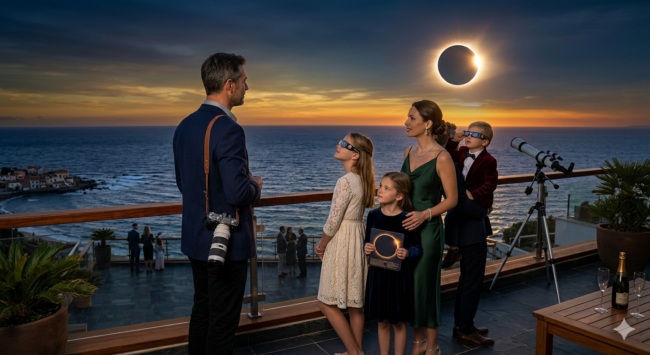
- Special eclipse glasses: They are the most widespread commercial option, but they demand maximum caution. They must strictly comply with the regulations. ISO 12312-2. You must check that the filter does not have even the slightest scratch, pinhole or crease. As an optical tip: insist that they put them on while looking towards the ground, look at the eclipse, and look down again before taking them off; most accidents happen in those few seconds of taking off the glasses while looking at the sky. Even with them on, it is not recommended to look continuously for more than 30 seconds. With children, take triple precautions: their lenses are very transparent, they let much more radiation through and any careless moment taking off the glasses could be disastrous.

Welding filters: It is an affordable alternative that tends to sell out in hardware stores, but mind you: only the glass for number 14 is available. If the patient is in any doubt about the rating or the filter is lower, it is completely not recommended. As with glasses, observation must not exceed 30 seconds at a time.
Indirect projection systems (Camera obscura): One of the cleanest and safest methods, ideal for doing as a family or with children. It involves passing sunlight through a small hole (a pinhole system) or using a small mirror covered with perforated paper to project the image of the Sun onto a piece of white card or a wall in the shade. Your eyes look at the screen, never directly at the Sun, which reduces the risk to zero.
Optical instruments (Telescopes and binoculars): It is the path that must command the most respect from us. You must never look through binoculars or a telescope without professional solar filters mounted at the light entry point (on the objective lens, never on the eyepiece). These devices act like a giant magnifying glass, concentrating the energy; looking without protection destroys the retina instantly in milliseconds. If you have no experience, it is better to go to certified astronomical societies.
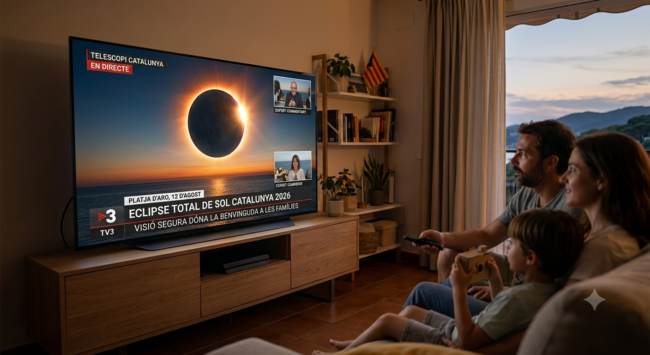
Screens (computer, television, etc.) and streaming (The Eye Health Advocate option): It may sound less romantic, but watching the eclipse on television or via live internet broadcasts (such as astrophysics channels on YouTube) is undoubtedly, the smartest and safest option. You can enjoy high-resolution images taken by professional telescopes, accompanied by expert commentary, with absolutely no risk to your eyesight.

Cameras and mobile phones: Trying to film or take photos of the eclipse directly with your mobile phone without a suitable filter can not only burn out the camera’s sensor, but also, when looking at the screen to frame the shot, puts you at risk of very dangerous direct flashes of light. It is not a safe way to enjoy the spectacle.
What we must NEVER allow (Myths to banish in optics)
As eye care professionals, we need to take common myths seriously. They are utterly useless. EXTREME CARE WITH:
Wear conventional sunglasses, no matter how dark they are, nor put on two or three pairs of sunglasses stacked one on top of the other. They do not have the necessary optical density to block the Sun's infrared and ultraviolet radiation.
X-rays, photographic negatives, glass smoked with a candle or out-of-print CDs. They give a false sense of darkness but let harmful radiation straight through to the macula.
If any patient ignores these warnings and after the eclipse notices a central blurred spot or persistent photophobia, the instruction must be clear: go immediately to the eye emergency department or to our centre to evaluate the fundus of the eye as soon as possible.